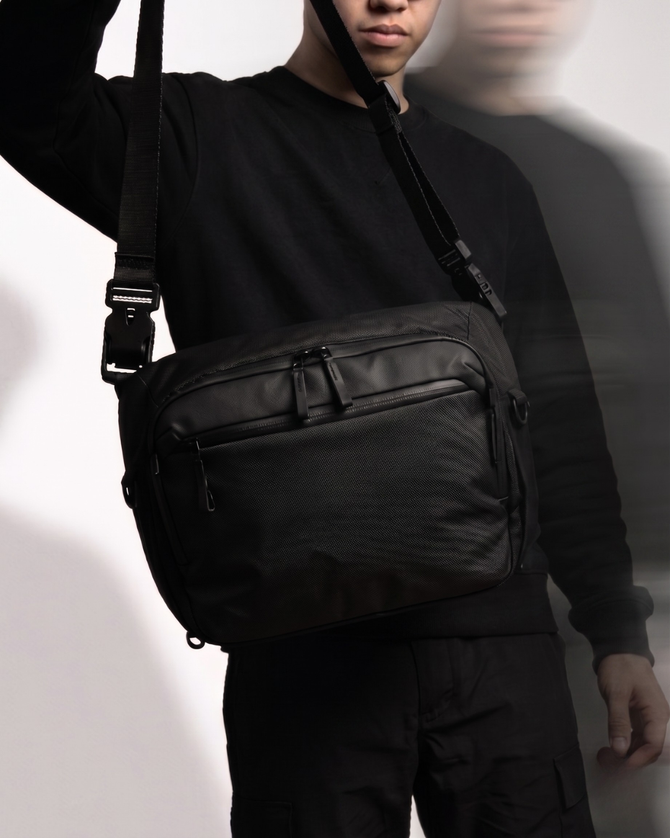



About Urbanomics
OUR STORY
One Singapore-based carry brand. Two founders. We spent years selling, testing and carrying dozens of bags before building one ourselves.
Every product starts with a problem we personally experienced.

This page is our story: Where we started, what we believe in, and exactly how the Urban Nomadic Everyday Sling 9L was designed from the ground up.
Chapter 01
THE IDEA THAT WOULD NOT GO AWAY
It started the way most real ideas start. Yes, frustration.

We spent years buying, carrying and selling bags from brands across the globe. We knew what the market offered. We knew what it kept getting wrong.
The same gaps kept showing up: Bags that looked right but carried wrong. Sleeves with no real protection. Bases that collapse the moment they were set down. Buckles that needed
The same gaps kept showing up. Bags that looked right but carried wrong. Sleeves with no real protection. Buckles that took both hands and half a minute to adjust. Interiors impossible to read in dim environments. Materials that looked premium but failed in six months.
New releases came. The gaps remained. And we stopped waiting.
Chapter 02
6 Failures Nobody Was Fixing
Before we designed a product, we wrote down every failure in a requirement list. Every problem we had personally experienced across every sling we ever owned, carried, or sold.

Every sling we tested before building our own.
| # | The Problem | What We Experienced |
| 01 | No bottom protection for iPad sleeve | Most slings place padding on the back panel facing the body instead of the ground. When the bag drops, the device absorbs the full impact directly. |
| 02 | The bag collapsed when set down | Place most slings on a table and they tip over. Takes ten seconds propping it against something every single stop, everyday. |
| 03 | Taking too long to adjust carry position | Chest to side, then to back required removing the bag, loosening, repositioning, re-tightening. Thirty seconds with both hands. |
| 04 | One handle for everything | A single handle for a bag picked up, set down, and stacked on luggage. |
| 05 | Interior that is impossible to read | Dark lining inside a dark bag, and items disappear on every open. Digging becomes the defining experience of the bag. |
| 06 | Wrong choice of materials | Thin nylon that scuffs, coated fabrics that crack, and soft shells that absorb water. Materials that look good in photos and fail in actual conditions. |
“Every one of those failures became a requirement. The process of closing them starts with the Urban Nomadic EDC Sling.”
Chapter 03
BEFORE FABRIC, THERE WAS PAPER
Before sourcing a single piece of material, we built the bag from paper, tape, and cardboard.
Base width, handle position, and what a 9L looks like at actual volume on an actual frame. These can't be answered on a screen. We had to answer them by building paper models.
13 paper versions were built before the structure held. Each one was folded, worn, adjusted, torn apart, and rebuilt. It taught us more about the bag than any software or AI ever could.
Now came the harder problem: finding someone capable of building it.

Early paper prototype. Three versions before this one was right.
Chapter 04
THE SEARCH FOR SUPPLIERS
Building a bag from scratch means finding the right people to build it. This process alone was longer and more challenging than what we've expected.
We reached out to multiple suppliers across Mainland China. Factories specialising in carry gear, tactical bags, and premium outdoor equipment. We sent spec sheets, reference photos, and detailed questions about stitching standards, and material sourcing. Some replied fast. Some went silent. Some sent samples that looked nothing like what we asked for.
Every exchange taught us something. How to write a brief that left no room for misreading. Which factories understood quality versus which ones were optimising for speed. What would reveal whether a factory actually cared about the quality and build of the bags.
At one point, remote communication was no longer enough. We flew to them.
Chapter 05
14 DAYS IN CHINA
Both of us flew to China for 14 days. Not for a sourcing tour or a holiday, but a business trip with one purpose: to find the right factory, touch the right materials in person, and confirm that the bag we had been designing for months could actually be built to the standard we needed.

We visited multiple factories. Some were large operations running dozens of production lines. Others were smaller workshops where every stitch was done by hand. We were not looking for the biggest factory. We were looking for the most attentive one.


Inside the factories we visited
At every stop, the assessment was the same: whether the factory personnel engaged with technical corrections or resisted them, whether they cared about the details the same way we did, and whether they could glance at a spec sheet and immediately understand what we were trying to achieve.
Machinery is replaceable, but the quality of attention isn't. We kept going until, we eventually found one.
Chapter 06
FEELING THE MATERIALS IN PERSON
A material cannot be chosen from a photo. Spec sheets cannot replace what physical handling reveals. We handled every fabric in person before any decision was made. Bent it, scratched it, stretched it, and stressed it.
During the trip, technical fabrics like Ballistic Nylon, X-Pac, and Dyneema were evaluated on-site. Each one performs differently and tells a different story about a bag.

Assessing various fabric options
| Material | What It Is | Our Verdict |
| Ballistic Nylon | Originally developed for body armour. Dense, tightly-woven, highly resistant to abrasion, tearing, and puncture. | Selected. Durable enough for daily punishment, and structured enough to hold the bag's form. |
| X-Pac | Laminated composite from sailing and ultralight outdoor gear. Lightweight, waterproof, distinctive cross-fibre appearance. | Impressive but did not fit the Nomadic's identity. Set aside for a future product. |
| Dyneema | One of the strongest fibres by weight. Used in bulletproof vests and ultra-premium carry gear. | Extraordinary material. Price point places it on the roadmap for future development. |
Ballistic nylon was the clear and right call. It is a deliberate choice made with full knowledge of every other alternative.
Chapter 07
STITCHING IS EVERYTHING
A bag can be made from the best material in the world and still fall apart at the seams. The quality of stitching is the difference between a bag that lasts two years and one that lasts a decade.
At every factory, stitching was the first thing we checked. Stitch density, thread tension, seam finishing at high-stress points. Whether bar tacks were correctly placed and corners reinforced, or simply folded and sewn over.
Then we gripped every seam and tested it under force. A bag that cannot survive a pull test cannot survive daily carry. We eliminated every factory that did not pass.


Inspecting stitching quality up close at the factory
The factory we chose passed every test. More importantly, they understood why we were testing. They welcomed the scrutiny. That settled the partnership. Prototyping could begin.
Chapter 08
11 ROUNDS OF PROTOTYPING
Signing a factory is not the end. It was the beginning of a new set of problems.
We carried each prototype hard for a full week in Singapore. Took it apart at the end, went back with a list of everything that wasn't right. Four key reiterations over months before a single unit was approved for production.
Reiteration #1
STRUCTURE FIRST
First physical sample in fabric: testing whether the structure held the form we had built in paper. The base needed to stand on its own. It came back close, but the base wasn't rigid enough.

Reiteration #2
THE CARRY TEST
Base reinforced. Handles repositioned. Worn for a full week in Singapore. The strap padding wasn't distributing load correctly. The false bottom foam density needed adjustments. Zipper pulls needed to be longer for true one-handed access.

Reiteration #3
THE DETAIL TEST
Strap padding revised. False bottom foam corrected. Zipper pulls updated. Interior lining colour confirmed as high-visibility orange. Buckle position for the tactical adjuster locked in. And branding placement finalised.


Reiteration #4
THE FINAL SAMPLE
Everything came together. Every correction from reiteration one through three held. The bag stood on its own. The strap distributed load correctly. The false bottom sat exactly where it needed to. The three handles were in the right place. The orange interior lit up the moment the bag was unzipped. We signed off.
This is what was built.

“Every round was a chance to get closer to the bag we had in our heads. We did not stop until the one in our hands matched it.”
The Result
EVERY FEATURE IS AN ANSWER
Every feature closes one problem from our requirement list.
Feature 01
THE FALSE BOTTOM
The iPad sleeve has a foam padding layer positioned directly beneath the device. Not on the back panel, but just beneath the device. Impact travels down, and the protection sits where the impact lands.

Feature 02
SELF-STANDING BASE
A structured base panel keeps the bag upright when set down on any flat surface. Set it down, and it stays. This sounds small until you have spent years owning bags that do not have this feature.

Feature 03
THREE HANDLES
Most slings have one handle. Two at most. The Urban Nomadic Sling has three. Left side grip. Right side grip. And a top handle for luggage pass-through. Each handle doubles as an attachment point for carabiners, sunglasses clips, and key loops. One handle covers one situation. Three handles cover all of them.


Feature 04
ONE-SECOND TACTICAL ADJUSTER, THREE CARRY POSITIONS
Chest carry. Side carry. Back carry. The strap adjusts in under a second. Another hand stays free, and the bag stays on your shoulder. The carry position changes with your environment. We built the entire strap system around it.

Feature 05
BALLISTIC NYLON EXTERIOR. ORANGE INTERIOR.
Ballistic nylon was originally developed for body armour. Their original brief was identical to ours: take the damage so what's inside does not. High-visibility orange interior means your gadgets surface immediately when the bag is unzipped.

Feature 06
STRAP & AEROFOAM® PADDING
Standard strap builts use whatever foam a factory has in stock. We did not accept that. Aerofoam® is a proprietary foam compound we developed specifically for this bag.
We engineered it to distribute load evenly and resist compression over months. It stays breathable even in South East Asia's heat. The profile stays slim, yet with full on protection for your shoulders.
This is not an off-the-shelf solution. It took multiple reiterations to arrive at the right density and structure. The result is a strap that carries comfortably across a full day without leaving your shoulder sore by evening.


Feature 07
MODULAR COMPARTMENT SYSTEM
The main compartment of the Nomadic is not fixed. Removable dividers let you reconfigure the internal layout for whatever the day calls for.
Set for a standard commute, the dividers create quick-access pockets and clean central storage. Reconfigured for a shoot, the layout cradles your camera body and lens alongside daily essentials. The bag adapts to your mission. One bag. Multiple configurations. Zero compromises.

The Capacity
MOST IMPORTANTLY: WHY 9 LITRES?
9L is the exact volume that replaces a backpack for a focused day out. Tablet. Daily essentials. Water bottle. Everything that matters.
The Nomadic was designed to be the sling you reach for when a backpack is more than the day calls for, and a small sling falls short. That gaps is where the 9L lives.

Built for Every Day.
If You Carry Daily,
This is Built for You.
Two founders. Tons of bags tested. Every gap on that failure list closed in 11 prototypes. All in one bag.
Shop the Nomadic Sling